
Pile drilling
Boring for cast-in-place piles under buildings, retaining walls and industrial structures.
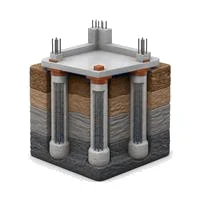
On weak ground or under heavy loads, foundations are carried down to firm strata on piles. Holes are bored to the design diameter and depth, then a rebar cage is set and concrete poured. This service is for contractors and clients who want bored piles delivered as a finished package of work.
When piled foundations are needed
- the upper ground is weak: made ground, soft clay, waterlogged sand;
- the building is tall or the load is heavy, beyond what a shallow foundation can carry;
- groundwater is high and a wide excavation is hard to dig;
- the work is next to existing buildings that must not settle;
- slopes, riverbanks and retaining walls need support against sliding.
Whether piles are needed is decided by the designer from the site investigation results.
Pile types and diameters
Diameter and depth are calculated in the design for the load and the ground. As a rough guide:
| Diameter | Typical use |
|---|---|
| 300–500 mm | fences, light structures, private houses, anchor supports |
| 600–1000 mm | multi-storey and industrial buildings, pile walls |
| 1000–1500 mm and more | high-rises, bridge and flyover piers, heavy machinery bases |
Piles bored in a line, with gaps or overlapping, form a pile wall. It holds the sides of a deep excavation and protects neighbouring buildings.
Drilling methods
With the kelly method the tool hangs on a telescopic bar and is lifted out and emptied each time it fills. It suits large diameters and depths as well as stony and dense ground. In unstable ground the hole walls are held by casing or bentonite slurry.
With a continuous flight auger (CFA) the auger is screwed to full depth in one pass and concrete is pumped through its hollow stem as it comes out. It is fast, with little vibration or noise, which suits work next to existing buildings.
We propose the method to suit the ground, the pile sizes and the site. More on the machines themselves is in the “Pile drilling rigs” section.
Quality control
- checking the position and verticality of every pile;
- measuring depth and cleaning cuttings from the base;
- checking the cage against the design and keeping it centred;
- continuous bottom-up concreting with the volume recorded;
- a drilling and concreting record for each pile.
Where the design calls for it, pile integrity and load capacity are checked by testing.
Work sequence
- Reviewing the design, the geotechnical report and the pile layout.
- Preparing the site: a level, firm working platform for the rig.
- Surveyor setting out the pile positions.
- Drilling, placing the cage, concreting.
- Preparing for pile heads to be cut down to design level.
- Handing over as-built records.
When you get in touch, send the number, diameter and depth of the piles, the site address and, if you have them, the design and the geotechnical report.